Showing posts with label environmental justice. Show all posts

Friday, April 20, 2012

Everything's Cool - Politics of Climate Change

Watch the documentary "Everything's Cool" which is available on Netflix  http://movies.netflix.com/WiPlayer?movieid=70059382
and may be available on YouTube or other sites.


Read the New York Times Movie Review of it which can be found at http://movies.nytimes.com/2007/11/23/movies/23cool.html

Visit
http://www.everythingscool.org/ the website from the film.

and then...

Answer the "EVERYTHING’S COOL" questions – Answer on a separate sheet. Please copy the questions and use full sentences that make sense. Please proofread for clarity – make sure your ideas come through.
1. What is the filmmaker’s point of view? (In other words, what is his position on climate change AND on the way politics is related to it?)
2. Do you think they have presented convincing evidence for the argument they are making? Give one or more examples from the film to support your opinion.
3. As a society, we make decisions through the political process. Do you think science is being considered fairly in the political process? Explain one way you believe the political process could be improved so science could be used better in decision making.
4. What are your overall reactions to this film? Explain at least two things you learned from it. 

Wednesday, March 21, 2012

Our Ecological Footprint

The following link will take you to a website at which you can calculate your own ecological footprint.  

http://files.earthday.net/footprint/flash.html


Follow the steps below and answer the questions as you work. 

1. Go to the site and select the United States as your location. Why do you think the site gives you different choices of countries and continents? Do you think ecological footprints the same or different in different locations?

2.  Before you begin, predict how many planets it takes to support your lifestyle.

3. When you get started you don’t have to put in your e-mail… just get started. You will have a choice between “Basic Information” and “Detailed Information.” Please select detailed information so you can get an idea of all the factors that go into your footprint.

4. Why do you think the types of meat and dairy foods you eat are important to your footprint?

5. You may not know where your food comes from… If you grow a garden or buy food at a farmers market, it is grown nearby. If you eat fruits and veggies in the winter in Chicago, that produce must have been grown far away. Why do you think the distance your food travels is important to your footprint?

6. Click on the different types of housing to see which is closest to the building in which you live. Why does the type of house or apartment you live in matter? 

7. Would having more people living in your household make your footprint bigger or smaller? Why?  

8. Here in Chicago, most of our energy does NOT come from renewable resources. Our homes are mostly heated with natural gas and our electricity comes mostly from burning coal and nuclear plants. Unless you have solar panels on your home or a wind turbine in your yard you use 0% renewable energy. Just estimate as well as you can when it asks you about how much your household spends on gas and electricity.

9. When you are answering questions about travel, keep in mind that it is about one mile between Armitage and Diversy or between Cicero and Pulaski. Big main streets in Chicago are about a mile apart. A typical large SUV gets about 13 miles per gallon (MPG) and a  small car such as a Honda Civic gets about 20 MPG. A hybrid Prius can get about 40 MPG.

10. Summarize your ecological footprint:
How many Earths?_____ How many acres? _____ Tons of carbon dioxide?_____
Roll over the pie chart to get % for Food ____ Shelter _____ Mobility _____ Goods ____ Services ______
Which 2 areas do you have the most control over? _____________________________________________

11. Explore the site for a few minutes and write about some actions you can take to reduce your footprint.  What is one action you are ready to take?

12. Please comment on your footprint in the comments section of this post.  Was your footprint more or less than you expected? What was most interesting about the questions on the quiz? What was most interesting or surprising about your results?  What changes do you think you will make? Please describe the experience of finding your environmental footprint. Sign your comment with your first name and last initial to get credit.


You can learn more about how the Ecological Footprint idea got started by watching all or part of the movie at the following link. 

http://www.epa.vic.gov.au/ecologicalfootprint/about/documentarydvd.asp

Tuesday, March 6, 2012

Local Activism and Environmental Justice

What is Environmental Justice?


Delegates to the  First National People of Color Environmental Leadership Summit came up with these Principles of Environmental Justice:  http://www.ejnet.org/ej/principles.html

What do you think about these principles? Are they fair? Are they useful? Are they realistic? What would the pros and cons be if these principles were to be adopted?

The Environmental Justice Leadership Forum crafted this statement about climate change and environmental Justice http://weact.org/Portals/7/EJ%20Leadership%20Forum%20Principles.pdf  

What do you think about these Principals of Climate Justice? How are they similar to and how are they different from the First National People of Color Environmental Leadership Summit principles?


This article about asthma rates in children in the Humboldt Park Neighborhood makes the point of the negative impacts environmental conditions can have on kids. http://www.ncbi.nlm.nih.gov/pmc/articles/PMC2912879/


Some Local Chicago environmental groups:

 P.E.R.R.O. Pilsen Environmental Rights and Reform Organization http://pilsenperro.org/

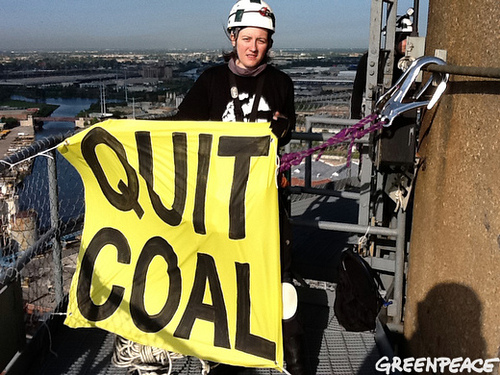
Video about the Greanpeace / PERRO action at the Fisk Coal Burning PowerPlant http://www.youtube.com/watch?v=yUqEWfO8RPQ

The Little Village Environmental Justice Organization http://lvejo.org/  gives "Toxic Tours" of their neighborhood to highlight the serious sources of pollution. The other programs their organization supports are listed below:

Current Campaigns:
  • Climate Justice - A vision to dissolve and alleviate the unequal burdens created by climate change.
  • Clean Power – We sought to have the two largest polluters (Crawford and Fisk Power Plants) in our backyard removed.
  • Public Transit – Works to improve fair access for all Chicagoland riders, but focuses special attention on helping transit dependent, low-income riders in Chicago’s poorer communities. A city that works, is a city that serves the needs of ALL it’s riders.
  • Water Wars - A campaign to keep our water in public hands, and defend everyone’s right to safe, clean and affordable water.
  • Urban Land- Pooling our common knowledge and interests, and working with Mother Earth to produce healthy and safe local food sources.
  • Open Spaces - Little Village, (95,000 residents), has been fighting for a park for over 10 years. In June ’07 the City of Chicago and Chicago Park District announced they would build a park on the Celotex Superfund toxic waste site. We want a SAFE park!
  • YAOTL -Youth – Work on issues that support a fair environment for the community members. Some of the tools we use to combat these injustices are embracing our artistic abilities , making documentaries, videos, newsletters, and most important building ourselves into strong leaders through our community for our community.
  • Toxic Tours – Take a Toxic Tour of the former Celotex Superfund.
    See the danger in your own backyard – for real!


The Healthy Schools Campaign fights to improve health of students in low income communities in Chicago... their issues include obesity and asthma http://www.healthyschoolscampaign.org/programs/envjustice/

Climate Justice Chicago http://www.chicagocleanpower.org/ has fought against the dirty coal power plants in the city as well as other environmental justice issues.